

Advanced Planning & Scheduling (APS) is traditionally seen as an extension of ERP. ERP generates planned production orders on the assumption that capacity and materials are unlimited. APS was developed to address this gap, producing plans and schedules that reflect the real constraints. For decades, it has strengthened ERP with better insight, improved business results, and reduced the manual effort needed to build usable plans and schedules.
In production execution, however, a different reality often emerges. The production capabilities assumed in APS frequently don’t match what happens on the shop floor. If the plan asks for too much, the result is missed demand or inventory shortfalls. If it asks for too little, capacity goes unused.
What if we approached APS from the perspective of the shop floor instead? Specifically, what if we measured every production run and changeover and then leveraged that data over time so that our APS assumptions were better aligned with current executional reality? Then our plans and schedules would paint a more accurate picture of the business going forward, enabling better decisions as things change and new opportunities arise.
Production Excellence Means Making the Right Stuff, Not Just More of It
At QAD | Redzone we speak often about our customers being “champions of manufacturing,” but what does that mean? That your production lines run well with minimal downtime? That your front line people are so empowered to improve production execution that they don’t want to leave? Yes, these are good things, and a connected workforce solution can drive these benefits. But there’s more to production excellence than execution.
Say you can produce 25% more than you could before. That’s great, but the next question is “Are you making the right stuff?” It doesn’t help your customer service or your inventory positions if you’re not. Who is figuring that out? That’s where Advanced Planning & Scheduling comes into the picture.
What Is Advanced Planning? Demand, Capacity and Scenario Planning
Demand Planning: Building a Reliable Demand Signal
Advanced Planning starts with a better understanding of your demand. What do you expect your customers to need over the upcoming days, weeks and months? Statistical forecasting based on sales history is an important starting point and systems can calculate the best statistical method to use in each situation. In addition, machine learning algorithms can be used to glean even more information from external data sources. While statistical forecasting methods and machine learning algorithms can certainly help to better understand your demand, that’s just the math. Demand Planning is about a collaborative process that can take into account many stakeholders (e.g. customers, sales, operations, etc.) and their opinions to reach a consensus about what the demand signal is looking like going forward. A better demand signal reduces variabilities and increases accuracy, but that’s not all that is needed to make the right stuff.
Constrained Planning: Working Within Capacity and Material Limits
The next question is whether there is enough manufacturing capacity and materials to make all of that demand in time. Traditional ERP planning in the form of DRP/MPS/MRP (Distribution Requirements Planning/Master Production Scheduling/Material Requirements Planning) assumes infinite capacity and alerts when demand exceeds capacity, but does not help you figure out what to do. Advanced Planning takes into account capacity and material constraints and creates a production plan that lives within those limitations. Sometimes that means making things weeks earlier when capacity is available. Sometimes that means producing on an alternate, non-preferred line. Sometimes that means moving production to another plant or to a co-manufacturer. Even after considering all of those options, it still may not be possible to supply everything that is needed. In that case, Advanced Planning can show what demand will not be satisfied or what inventory levels cannot be maintained. Item and customer prioritization can help determine what makes it onto the production plan and what doesn’t, what can be filled on time and what will be late. If outsourcing to a co-manufacturer is an option for meeting requirements that cannot be met with your own resources, then financial considerations of making versus buying can play an important role in terms of evaluating the feasibility and desirability of those options.
Scenario Planning: Comparing Options Before You Commit
Lastly, Advanced Planning systems can allow for robust Scenario Planning, which enables the planner to evaluate and compare the various options and strategies along a number of KPI’s such as revenue, cost, margin, inventory, capacity utilization, etc. Scenario Planning is also an important part of higher level S&OP and SiOP processes.
Advanced Production Scheduling: Balancing Efficiency and Due Dates
Once we have chosen a feasible production plan that prescribes what to make on each line by week, the next step is to work out the details by day, hour, and minute of exactly how to sequence that production throughout the week. That’s where Production Scheduling comes into play. We want to create an efficient schedule that minimizes the number of changeovers required, respecting sequencing considerations related to attributes such as allergens, colors, sizes, etc. By doing so, we reduce manufacturing costs and free up additional capacity. However, scheduling is not just about efficiency. The plant manager can already tell you the ideal sequence to run your products. The question in a dynamic manufacturing environment is how to be efficient and meet your due dates at the same time. That may require breaking from the ideal sequence from time to time to meet customer service requirements.
Once we have the best schedule, then it becomes a question of execution. No plan or schedule is meaningful if the shop floor can’t deliver.
Why Planning and Scheduling Fail Without Actual Run Rate and Changeover Data
Making the right stuff and in the right sequence will improve customer service, reduce inventories, increase line efficiency and avoid unnecessary overtime, all things that improve the bottom line. But your plan and schedule are only as good as the assumptions you make about production run rates, changeover times, and the people required. Poor assumptions can lead to unrealistic plans and schedules. The hard reality is that most organizations don’t really know their actual production rates and changeover times. Rate standards in ERP systems are often used for financial accounting purposes but do not necessarily reflect the realities on the shop floor. And oftentimes, changeover data is not tracked at all.
That’s where a Connected Workforce solution can be a game changer. By measuring each and every production run and changeover, you, in fact, create a database of actual performance that can be tapped to make your Advanced Planning & Scheduling assumptions more accurate, improving overall plan and schedule quality.
How Connected Workforce Data Creates a Continuous Improvement Loop
So you go live with Advanced Planning & Scheduling based on the best data you have at the time and you start reaping the benefits. Then what? As long as your execution performance doesn’t change, your assumptions are good. Unlike a Manufacturing Execution System (MES), which can also track performance, a Connected Workforce solution is all about empowering the people – the line workers on the shop floor – so that your production rates, changeover times, and ideal crew size improve over time. As you get better at manufacturing, you want these improvements to then drive updates to your planning and scheduling assumptions so that you can plan and schedule more aggressively and take advantage of that better performance. This combination of Planning, Scheduling, and Execution effectively drives a cycle of continuous improvement. Realistic plans and schedules drive realistic expectations on the shop floor. And as the shop floor moves the bar, planning & scheduling can adjust.
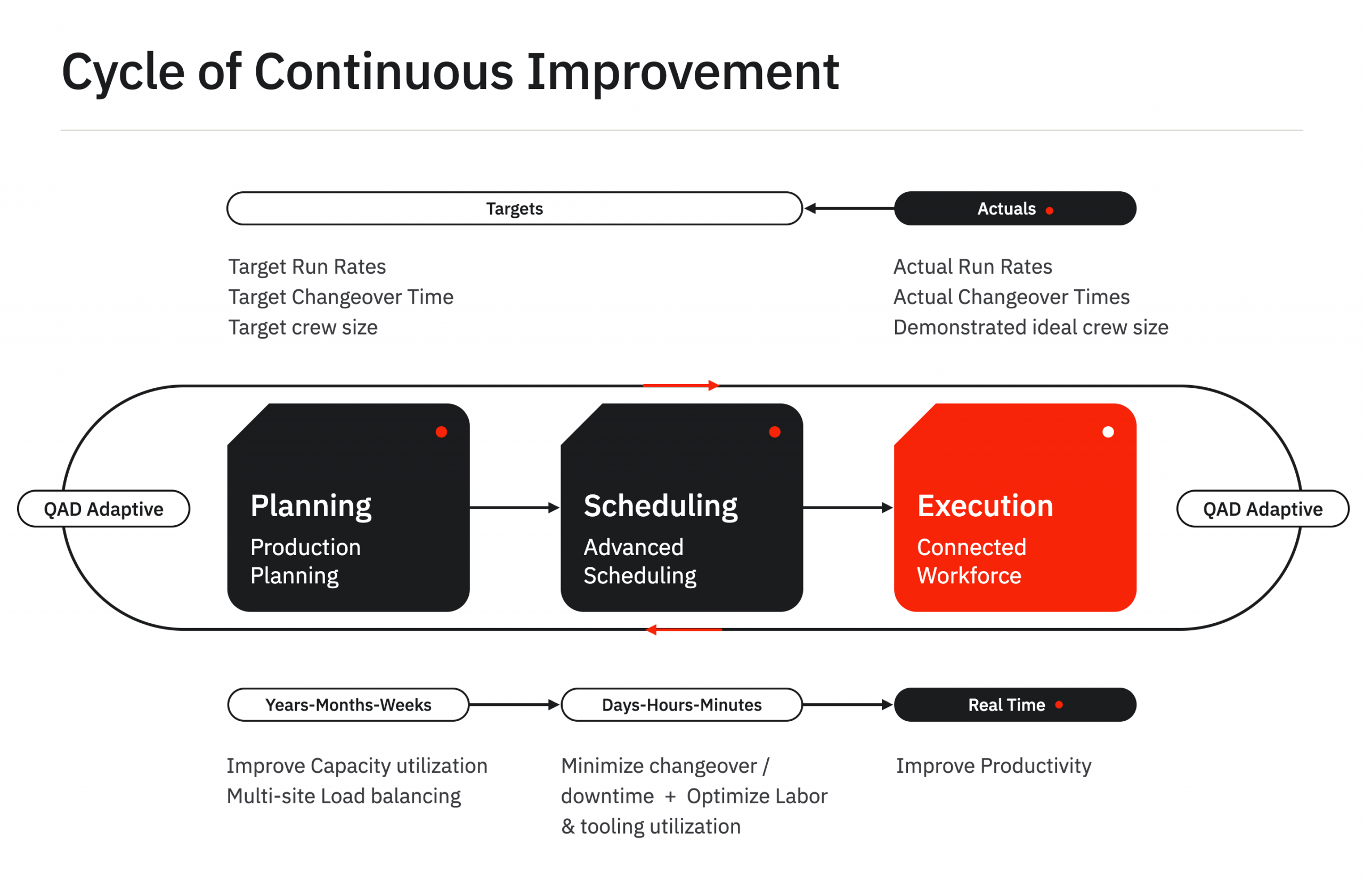
Production Excellence with QAD | Redzone: Planning, Scheduling, and Execution Together
QAD | Redzone, with its laser focus on manufacturers, has built a solution platform that uniquely combines Advanced Planning, Scheduling, and Connected Workforce to take you on a complete journey of Production Excellence. To be a true Champion of Manufacturing, you need to make the right stuff at the right time and be able to execute on the shop floor. And as your manufacturing gets better over time, you can leverage your additional capacity to improve the bottom line, driving a cycle of continuous improvement. This is just one of the many reasons why QAD | Redzone is the #1 Platform for Manufacturers.